The Tel Dan Stele: “House of David”
Pieces of a 9th-century BC Aramaic victory monument, found at Tel Dan in 1993 and 1994. Its phrase “House of David” is the earliest widely accepted reference to David outside the Bible.
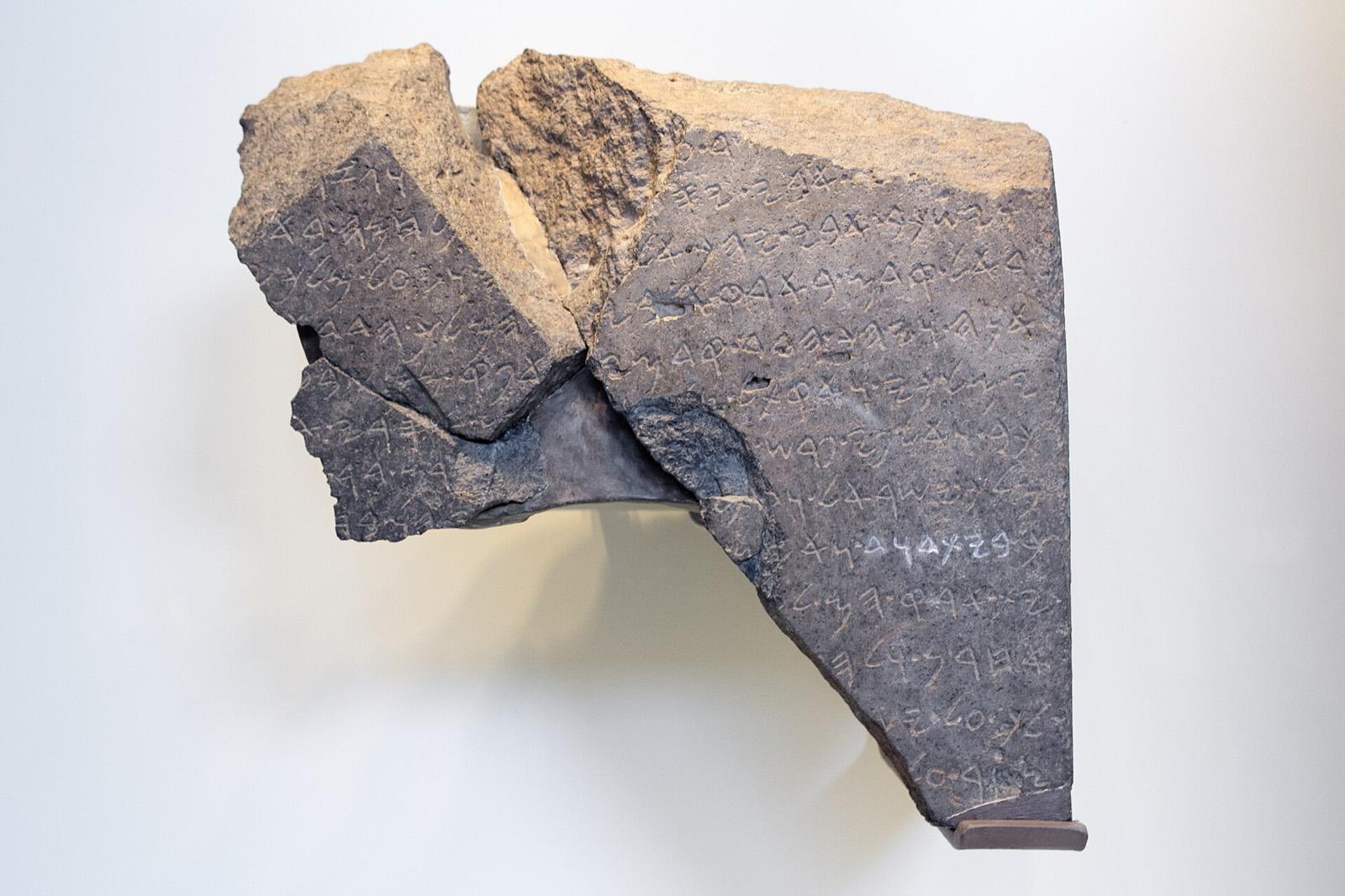

In July 1993 a team led by Avraham Biran was excavating near the city gate at Tel Dan when it found a broken basalt slab reused in a later wall. Two more fragments turned up in 1994. The text is in Aramaic. Most scholars think Hazael, king of Aram-Damascus, set it up in the second half of the 9th century BC to celebrate victories over his neighbors.
The writer boasts that he killed “[Jo]ram son of [Ahab], king of Israel” and “[Ahaz]iah son of [Jehoram], king of the House of David.” The names are partly restored, but the restoration is widely accepted, because the surviving letters and the context fit those two kings, who reigned at the same time.
The stele bears on 2 Kings 8–9 in two ways. It shows that Israel and Judah were kingdoms known to their neighbors, with Judah’s royal line named after David. It also differs from the Bible. 2 Kings 9 says Jehu killed Joram and Ahaziah, while the stele gives the credit to the Aramean king. Some scholars suggest Jehu acted as Hazael’s ally, or that each side claimed the same event. The Bible itself says Hazael had just fought Joram at Ramoth-gilead (2 Kings 8:28–29).
The fragments are displayed at the Israel Museum in Jerusalem.
Why it’s rated established
This rating covers the stele and its reading “House of David.” The fragments come from a controlled excavation and were published in a peer-reviewed journal; their authenticity is not seriously disputed. Most scholars read bytdwd as “House of David,” a dynasty name like “House of Omri,” and early alternative readings have found little support. The stele shows that a dynasty claiming David as its founder ruled Judah by the 9th century BC; it says nothing about the details of David’s own life.
Established: Excavated, published and broadly accepted by scholars, with a direct link to the biblical text. About the ratings
In scripture
Timeline
- c. 841 BCJehu seizes Israel’s throne; Joram of Israel and Ahaziah of Judah are killed (2 Kings 9).
- Late 9th century BCHazael of Damascus has the stele carved.
- 1993The first fragment is found at Tel Dan.
- 1994Two more fragments are found.
Sources
- Biran, Avraham, and Joseph Naveh. “An Aramaic Stele Fragment from Tel Dan.” Israel Exploration Journal 43, no. 2–3 (1993): 81–98. Link to this source
- Biran, Avraham, and Joseph Naveh. “The Tel Dan Inscription: A New Fragment.” Israel Exploration Journal 45, no. 1 (1995): 1–18. Link to this source
- Schniedewind, William M. “Tel Dan Stela: New Light on Aramaic and Jehu’s Revolt.” Bulletin of the American Schools of Oriental Research 302 (1996): 75–90. Link to this source
- Hagelia, Hallvard. The Dan Debate: The Tel Dan Inscription in Recent Research. Sheffield: Sheffield Phoenix Press, 2009.
Last reviewed October 14, 2026.