Tall el-Hammam and the Search for Sodom
A large Bronze Age city northeast of the Dead Sea, violently destroyed around 1650 BC by its excavators’ dating. Its excavator identifies it as Sodom; most scholars who look for Sodom favor other sites or doubt it can be located.
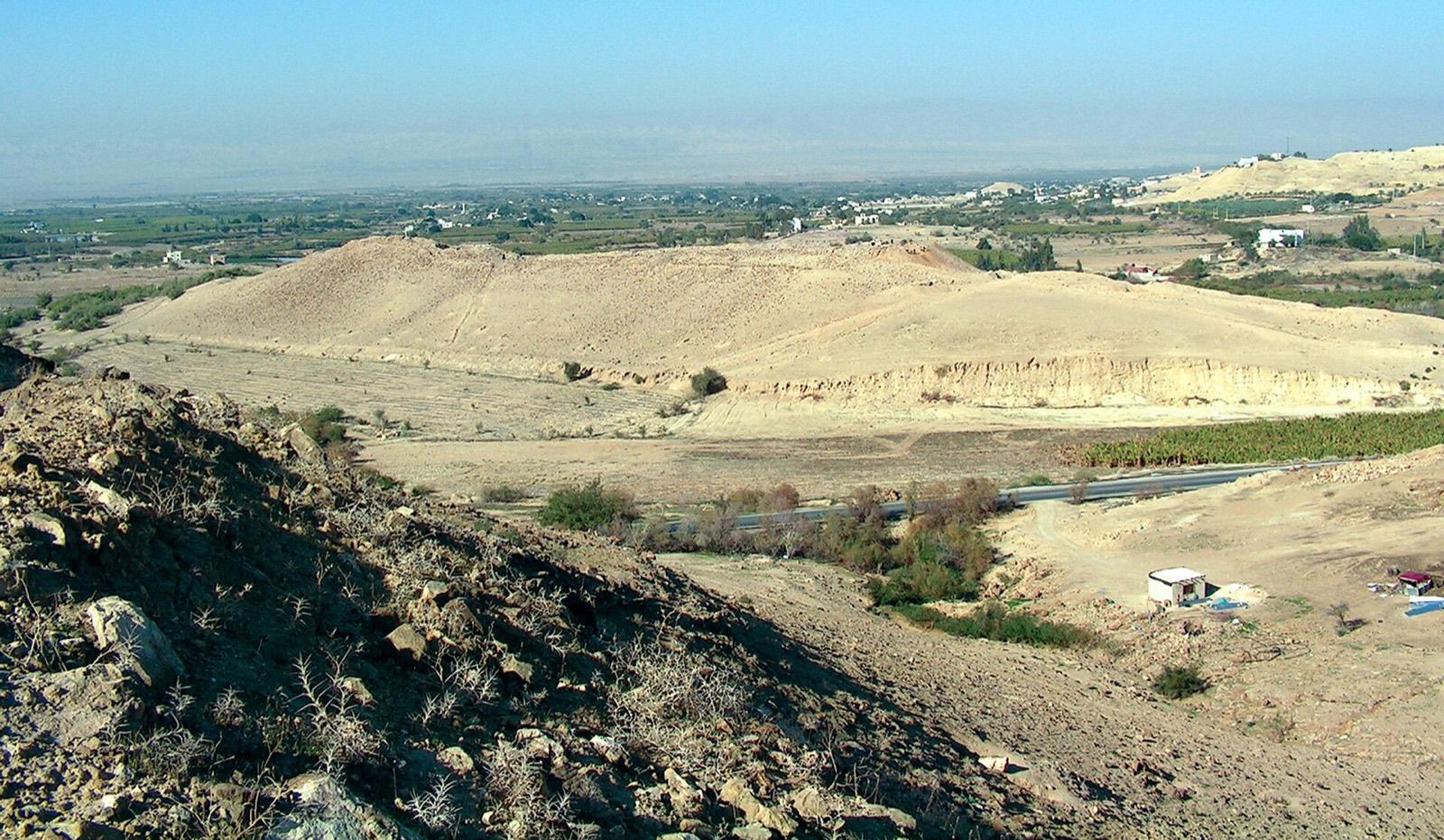

Tall el-Hammam lies on the plain east of the Jordan River, about 8 miles (13 km) northeast of the Dead Sea. Since 2005 a team led by Steven Collins, then of Trinity Southwest University in Albuquerque and later also of Veritas International University, has excavated it under Jordan’s Department of Antiquities. In the Middle Bronze Age it was one of the largest cities in the southern Levant, with massive fortifications. It ended in a violent destruction followed by centuries of near-abandonment.
Collins argues that it is Sodom. Genesis 13:10–12 says Lot looked out from near Bethel over “all the plain of Jordan” (the kikkar) and settled among its cities. Collins reads the kikkar as the round plain north of the Dead Sea, where Tall el-Hammam is the dominant site. Most earlier proposals put Sodom southeast of the Dead Sea, at sites such as Bab edh-Dhra. Some of the strongest objections come from other evangelical scholars, such as Bryant Wood and Eugene Merrill, who place Sodom south of the Dead Sea and centuries earlier. Many critical scholars read the Sodom story as a traditional account of the Dead Sea’s barren landscape and doubt it points to one site.
In 2021 a team of scientists that included Phillip Silvia of the excavation project published a paper in Scientific Reports arguing that a cosmic airburst destroyed the city, citing melted pottery and mudbrick, shocked quartz and scattered human remains. Genesis 19:24–28 describes fire and brimstone falling on the cities, so the claim drew wide attention. Other scientists challenged the evidence and the paper’s images. The authors corrected altered images in 2022 and a misused figure in 2023, and the journal added an editor’s note of concern in February 2023. In April 2025 Scientific Reports retracted the paper, saying it no longer had confidence in its conclusions; most of the authors disagreed with the retraction.
Watch
Why it’s rated debated
This rating covers the identification with Sodom. The excavation is real and extensive, and the destruction layer is well attested. The identification rests on reading Genesis 13:10–12 as placing the cities north of the Dead Sea, and it requires dating Abraham centuries later than the traditional biblical chronology. A 2021 paper attributing the destruction to a cosmic airburst was corrected twice and then retracted by its journal in 2025; most of its authors disagreed with the retraction.
Debated: Real evidence, but scholars disagree about its date or its connection to the biblical account. About the ratings
In scripture
Timeline
- c. 1650 BCThe Middle Bronze Age city is destroyed (the excavators’ date).
- 2005Excavation begins under Steven Collins.
- 2013Collins and Latayne Scott publish Discovering the City of Sodom.
- 2021The airburst paper is published in Scientific Reports.
- 2025Scientific Reports retracts the airburst paper; most of its authors object.
Sources
- Collins, Steven, and Latayne C. Scott. Discovering the City of Sodom. New York: Howard Books, 2013.
- Collins, Steven, Carroll M. Kobs, and Michael C. Luddeni. The Tall al-Hammam Excavations, Volume 1. Winona Lake, IN: Eisenbrauns, 2015. Link to this source
- Bunch, Ted E., et al. “A Tunguska Sized Airburst Destroyed Tall el-Hammam a Middle Bronze Age City in the Jordan Valley near the Dead Sea.” Scientific Reports 11 (2021): 18632. Retracted 2025. Link to this source
- “Retraction Note: A Tunguska Sized Airburst Destroyed Tall el-Hammam a Middle Bronze Age City in the Jordan Valley near the Dead Sea.” Scientific Reports 15 (2025): 14291. Link to this source
- Jaret, Steven J., and R. Scott Harris. “No Mineralogic or Geochemical Evidence of Impact at Tall el-Hammam, a Middle Bronze Age City in the Jordan Valley near the Dead Sea.” Scientific Reports 12 (2022): 5189. Link to this source
- Wood, Bryant G. “Locating Sodom: A Critique of the Northern Proposal.” Bible and Spade 20, no. 3 (2007): 78–84. Link to this source
- Schaub, R. Thomas, and Walter E. Rast. Bâb edh-Dhrâʿ: Excavations in the Cemetery Directed by Paul W. Lapp (1965–67). Reports of the Expedition to the Dead Sea Plain, Jordan 1. Winona Lake, IN: Eisenbrauns, 1989.
Last reviewed October 14, 2026.