The Assyrian Siege of Lachish
Sennacherib’s 701 BC campaign against Judah is recorded in his own annals, carved in palace reliefs of the siege of Lachish, and visible in the siege ramp still at the site. The Bible tells of the same campaign in 2 Kings 18–19, Isaiah 36–37 and 2 Chronicles 32.

In 701 BC Sennacherib of Assyria marched on Judah after King Hezekiah rebelled. His annals survive on clay prisms such as the Taylor Prism in the British Museum. They claim he took 46 walled cities and shut Hezekiah up in Jerusalem “like a bird in a cage.” They do not claim Jerusalem fell. They record Hezekiah’s tribute, including 30 talents of gold, the same figure given in 2 Kings 18:14. The annals do not name Lachish; the reliefs do.
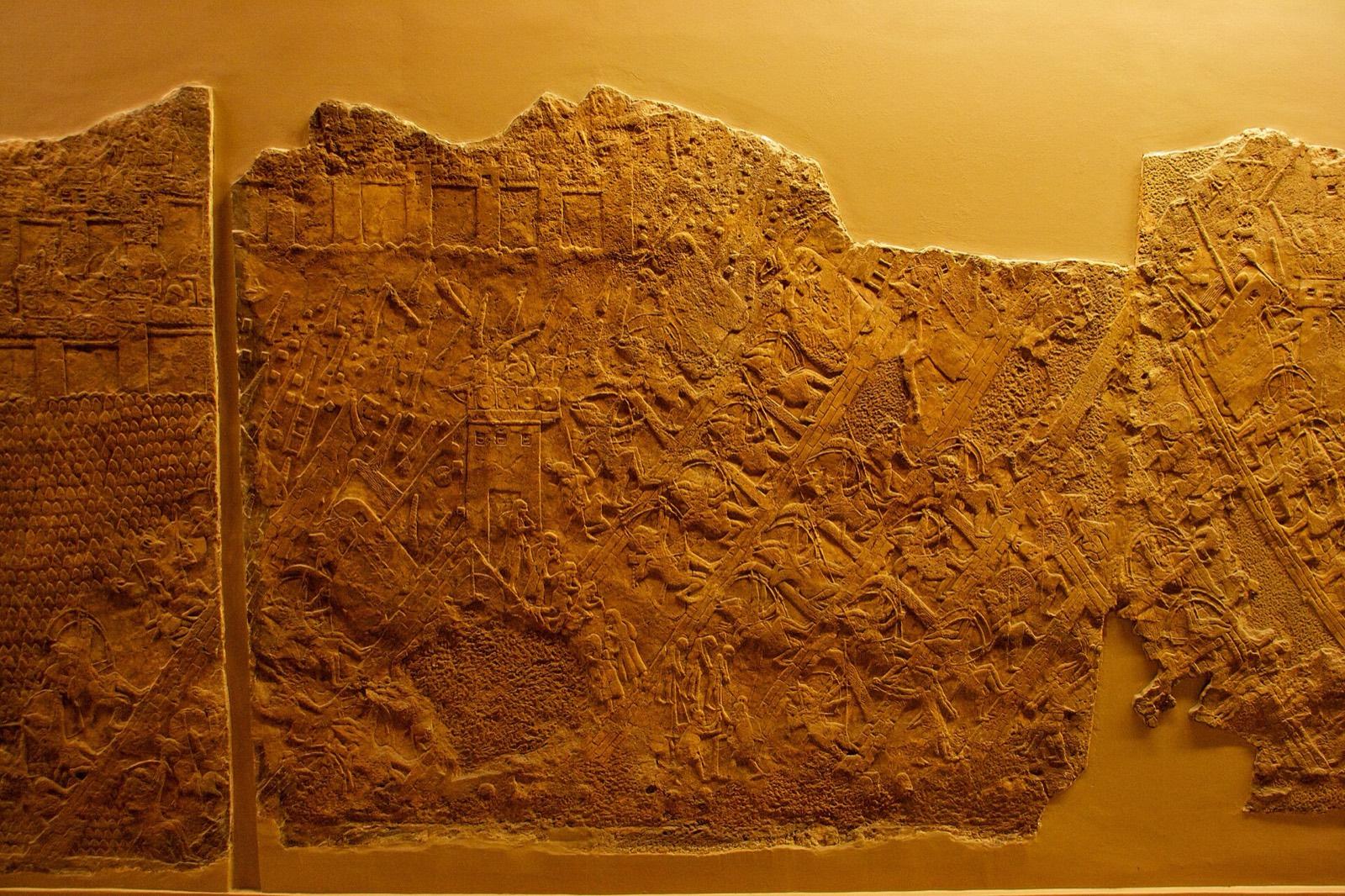
Lachish, Judah’s second city, is the centerpiece of a series of wall reliefs from Sennacherib’s palace at Nineveh, excavated by Austen Henry Layard in the 1840s and now in the British Museum. They show battering rams on a ramp, defenders on the walls, captives led away, and Sennacherib on his throne receiving the spoil of Lachish. 2 Kings 18:14, 17 and 19:8 place Sennacherib at Lachish.
Excavations at Tel Lachish, begun by James Starkey in the 1930s and above all those led by David Ussishkin from 1973 to 1987, exposed the Assyrian siege ramp, one of the earliest siege ramps known, along with a counter-ramp built by the defenders, arrowheads, sling stones and a thick destruction layer. Storage-jar handles stamped lmlk (“belonging to the king”), linked with Hezekiah’s preparations, were found in that layer.
The sources part ways at the end of the campaign. 2 Kings 19:35–36 says the angel of the LORD struck the Assyrian camp and Sennacherib returned home, while his annals report only success and tribute. Historians debate what happened, but all the sources agree Jerusalem was not taken.
Why it’s rated established
This rating covers Sennacherib’s campaign against Judah in 701 BC. Three kinds of evidence agree: Assyrian texts, Assyrian palace art and excavation at Lachish. They show that Sennacherib invaded Judah, took Lachish, and besieged Jerusalem without capturing it, as the Bible reports. Both the annals and 2 Kings record Hezekiah’s tribute, with the same 30 talents of gold, though they differ on the silver (800 talents in the annals, 300 in 2 Kings 18:14). They also differ on how the campaign ended: Sennacherib reports only success, while 2 Kings 19 reports a disaster for his army.
Established: Excavated, published and broadly accepted by scholars, with a direct link to the biblical text. About the ratings
In scripture
Timeline
- 701 BCSennacherib invades Judah; Lachish falls and Jerusalem is besieged (2 Kings 18–19).
- 691 BCThe Taylor Prism records the campaign in Sennacherib’s annals.
- 1830Colonel Robert Taylor acquires the prism near Nineveh.
- c. 1849Layard uncovers the Lachish reliefs at Nineveh.
- 1932–1938James Starkey excavates Lachish.
- 1973–1987David Ussishkin’s excavations expose the siege ramp.
Sources
- Ussishkin, David. The Conquest of Lachish by Sennacherib. Tel Aviv: Tel Aviv University, Institute of Archaeology, 1982.
- Ussishkin, David. The Renewed Archaeological Excavations at Lachish (1973–1994). 5 vols. Monograph Series of the Sonia and Marco Nadler Institute of Archaeology 22. Tel Aviv: Emery and Claire Yass Publications in Archaeology, 2004.
- Garfinkel, Yosef, Jon W. Carroll, Michael Pytlik, and Madeleine Mumcuoglu. “Constructing the Assyrian Siege Ramp at Lachish: Texts, Iconography, Archaeology and Photogrammetry.” Oxford Journal of Archaeology 40, no. 4 (2021): 417–439. Link to this source
- British Museum. “The Taylor Prism” (1855,1003.1). Link to this source
- British Museum. Lachish reliefs: Sennacherib receiving the spoil of Lachish (1856,0909.14.7). Link to this source
- Pritchard, James B., ed. Ancient Near Eastern Texts Relating to the Old Testament. 3rd ed. with Supplement. Princeton: Princeton University Press, 1969.
Last reviewed October 14, 2026.