The Pilate Stone
A limestone block found at Caesarea in 1961 that bears the name of Pontius Pilate and his title, prefect of Judea. It is the only known inscription from his lifetime that clearly names him.
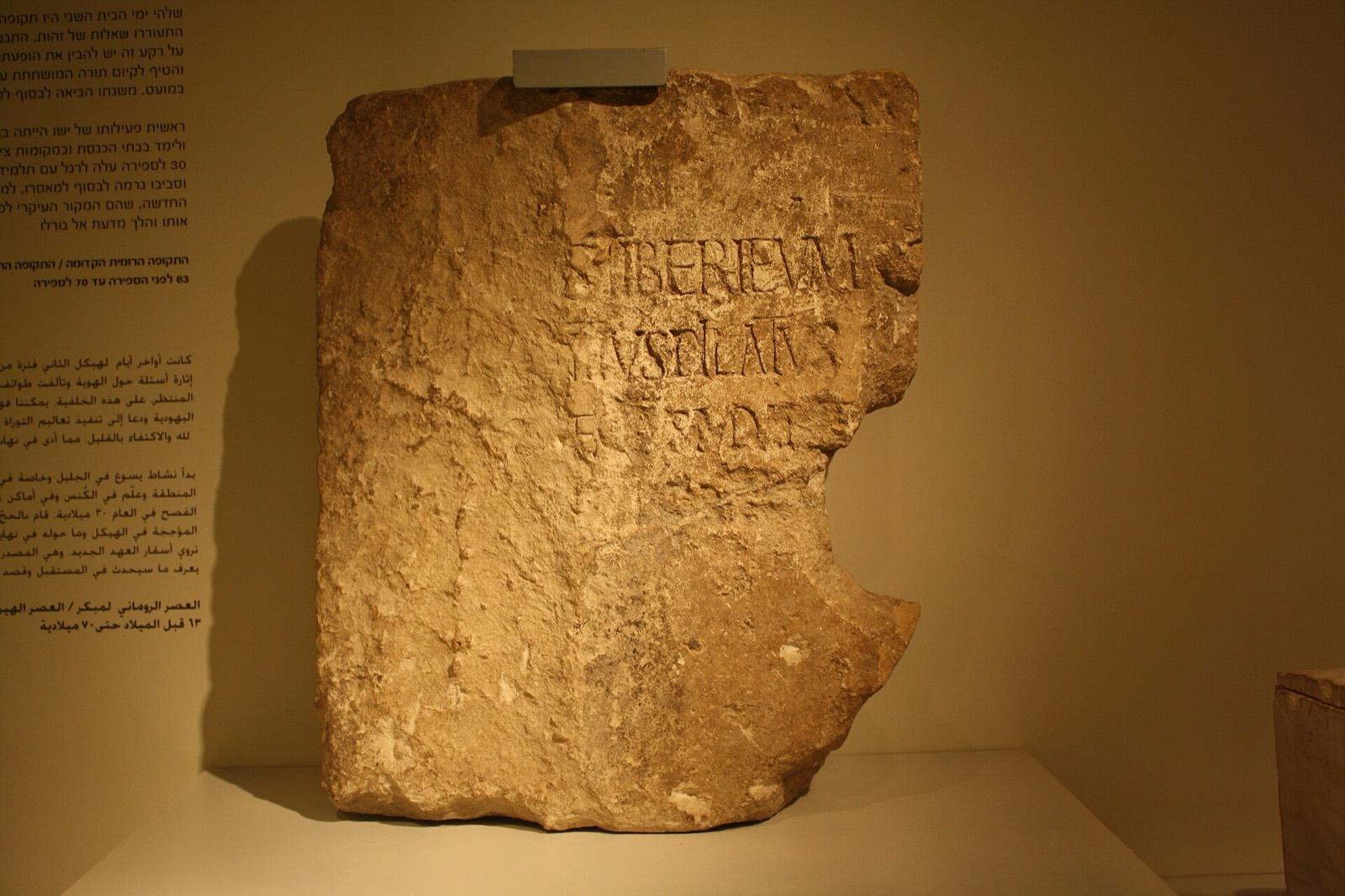

In 1961 an Italian expedition led by Antonio Frova was excavating the Roman theater at Caesarea Maritima, the seat of Roman government in Judea. A limestone block, reused as a step in a later rebuilding, carried part of a Latin dedication. Its lines read, in part, “Tiberieum … [Po]ntius Pilatus … [Praef]ectus Iuda[ea]e”: Pontius Pilate, prefect of Judea, had dedicated a building called a Tiberieum, in honor of the emperor Tiberius.
All four Gospels name Pilate as the governor who sentenced Jesus, and Luke 3:1 dates John the Baptist’s ministry to the time when “Pontius Pilate being governor of Judaea.” Josephus and Philo also write about him. The stone settles the title of his office. Before Claudius, Rome’s governors of Judea were prefects (praefectus), a military title, not procurators, as the later historian Tacitus called him.
The original is in the Israel Museum in Jerusalem; a replica stands at Caesarea.
Why it’s rated established
This rating covers the inscription and its naming of Pilate as prefect of Judea. Found in a documented excavation and displayed in the Israel Museum, the inscription is universally accepted. It confirms Pilate as a real Roman official in Judea who held the title praefectus, consistent with the Gospels, Josephus and Philo. Debate centers on details, such as what the building called the Tiberieum was.
Established: Excavated, published and broadly accepted by scholars, with a direct link to the biblical text. About the ratings
In scripture
Timeline
- c. AD 26Pilate becomes prefect of Judea.
- c. AD 30–33Jesus is tried before Pilate (Mark 15; John 18–19).
- AD 36/37Pilate is recalled to Rome.
- 1961Antonio Frova’s team finds the stone in the theater at Caesarea.
Sources
- Frova, Antonio. “L’iscrizione di Ponzio Pilato a Cesarea.” Rendiconti dell’Istituto Lombardo 95 (1961): 419–434.
- Alföldy, Géza. “Pontius Pilatus und das Tiberieum von Caesarea Maritima.” Scripta Classica Israelica 18 (1999): 85–108. Link to this source
- Israel Museum. “Pontius Pilate inscription” (IAA 1961-529). Link to this source
- Taylor, Joan E. “Pontius Pilate and the Imperial Cult in Roman Judaea.” New Testament Studies 52, no. 4 (2006): 555–582. Link to this source
- Bond, Helen K. Pontius Pilate in History and Interpretation. Cambridge: Cambridge University Press, 1998. Link to this source
- Josephus. Jewish Antiquities 18.55–64, 18.85–89. Philo. On the Embassy to Gaius 299–305. Tacitus. Annals 15.44.
Last reviewed October 14, 2026.