The Mesha Stele (Moabite Stone)
A basalt monument in which Mesha, king of Moab, boasts of throwing off Israel’s rule around 840 BC. It names Omri king of Israel and Israel’s God, YHWH, and tells the revolt mentioned in 2 Kings 1:1 and 3:5 from Moab’s side.
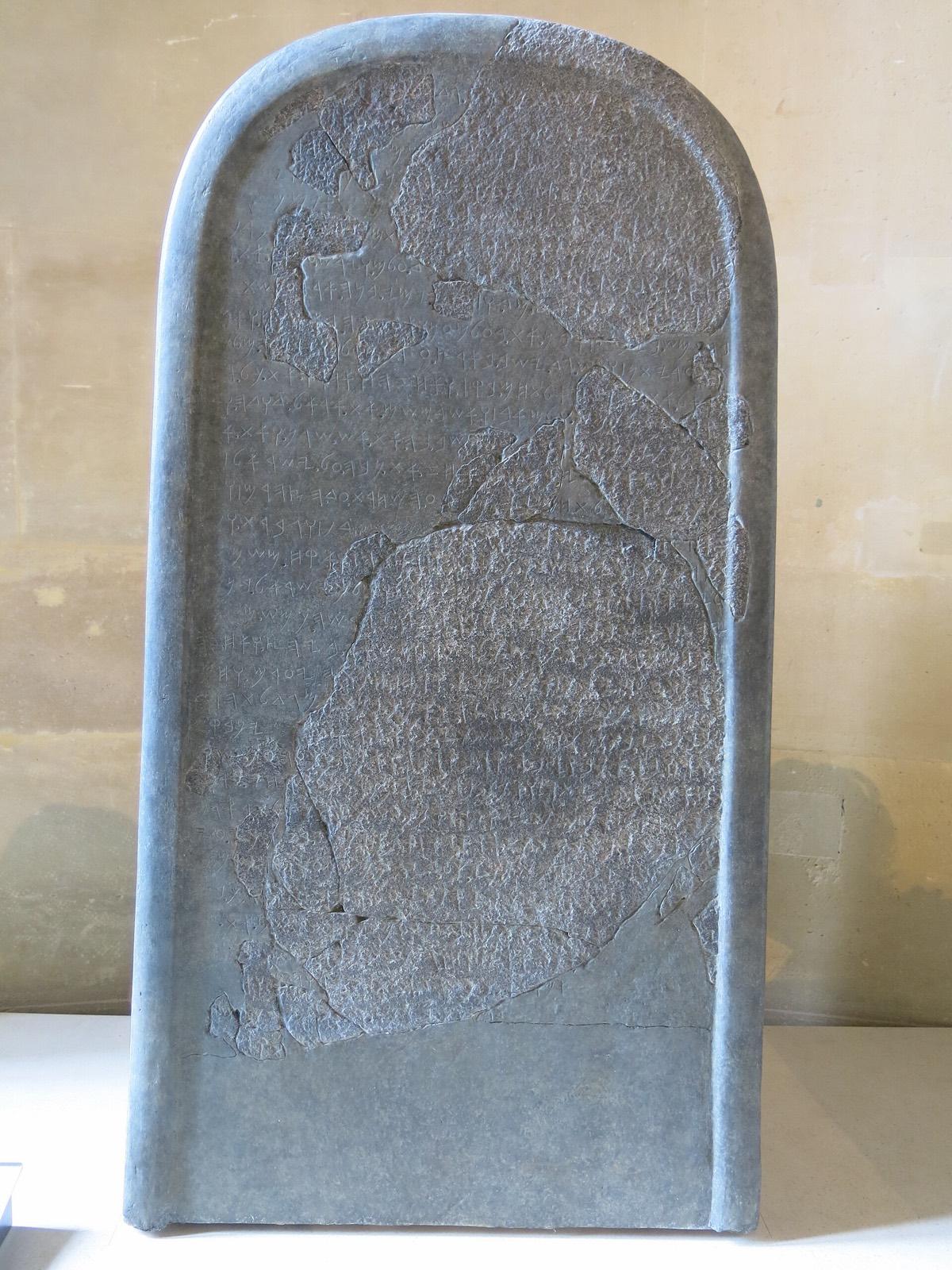

In 1868 F. A. Klein, an Anglican missionary, was shown a black basalt slab bearing 34 lines of writing at Dhiban, east of the Dead Sea. While European agents competed to acquire it, local people heated the stone and broke it apart with cold water in 1869. A squeeze (paper impression) made for Charles Clermont-Ganneau before the breakage, together with recovered fragments preserving about 600 of its roughly 1,000 letters, allowed the text to be reconstructed. The restored stele is in the Louvre.
Mesha says that “Omri was king of Israel and oppressed Moab many days,” and that his son continued to do so, until Mesha rebelled with the help of his god Chemosh. He describes taking Israelite towns such as Nebo and Ataroth, and dragging the vessels of YHWH before Chemosh (the word “vessels” is partly restored). It is the earliest undisputed mention of Israel’s God by name outside the Bible.
2 Kings 1:1 and 3:4–27 tell of the same rebellion. Mesha, a sheep-breeder who paid Israel a heavy tribute, revolted after Ahab’s death, and Israel, Judah and Edom marched against him. The Bible says the coalition was winning until Mesha sacrificed his eldest son on the wall, and “there was great indignation against Israel,” so they withdrew. Mesha’s stone records only his victories. It also seems to place the revolt in the reign of Omri’s son, while 2 Kings places it after Ahab’s death; scholars explain this in different ways, and “son” can also mean a later descendant. Read together, the two accounts show Moab’s revolt from both sides.
Why it’s rated established
This rating covers the stele as Mesha’s own record of Moab’s revolt against Israel. Europeans saw the stone intact in place, and a paper squeeze was taken before it was broken, so most of its text is securely known; it is one of the most studied inscriptions of the Iron Age. It names Mesha, Omri and Israel’s rule over Moab, as 2 Kings 1:1 and 3:4–5 do, though the two accounts describe different stages of the conflict and differ on its timing. A proposed reading of “House of David” in line 31 is possible but debated, because the letters there are damaged.
Established: Excavated, published and broadly accepted by scholars, with a direct link to the biblical text. About the ratings
In scripture
Timeline
- c. 840 BCMesha sets up the stele at Dibon.
- 1868F. A. Klein sees the stone at Dhiban.
- 1869The stone is broken; a squeeze taken earlier preserves the text.
- 1873The Louvre acquires the reassembled stele.
- 1994André Lemaire proposes reading “House of David” in line 31.
Sources
- Musée du Louvre. “Stèle de Mesha” (AO 5066). Link to this source
- Dearman, J. Andrew, ed. Studies in the Mesha Inscription and Moab. Archaeology and Biblical Studies 2. Atlanta: Scholars Press, 1989.
- Lemaire, André. “‘House of David’ Restored in Moabite Inscription.” Biblical Archaeology Review 20, no. 3 (1994). Link to this source
- Langlois, Michael. “The Kings, the City and the House of David on the Mesha Stele in Light of New Imaging Techniques.” Semitica 61 (2019): 23–47.
- Finkelstein, Israel, Nadav Na’aman, and Thomas Römer. “Restoring Line 31 in the Mesha Stele: The ‘House of David’ or Biblical Balak?” Tel Aviv 46, no. 1 (2019): 3–11. Link to this source
- Na’aman, Nadav. “The Alleged ‘Beth David’ in the Mesha Stele: The Case Against It.” Tel Aviv 46, no. 2 (2019): 192–197. Link to this source
Last reviewed October 14, 2026.