Hezekiah’s Tunnel and the Siloam Inscription
A 533-meter tunnel cut through bedrock to bring the Gihon Spring’s water inside Jerusalem, with a Hebrew inscription describing the moment the two digging crews met. Most scholars identify it with the work in 2 Kings 20:20, where Hezekiah “made a pool, and a conduit, and brought water into the city.”

The Gihon Spring, Jerusalem’s main water source, rises in the Kidron Valley below the eastern side of the City of David. Hezekiah’s Tunnel carries its water through the hill to the Pool of Siloam on the other side. It winds for about 533 meters, with a drop of only about 30 centimeters along its length.
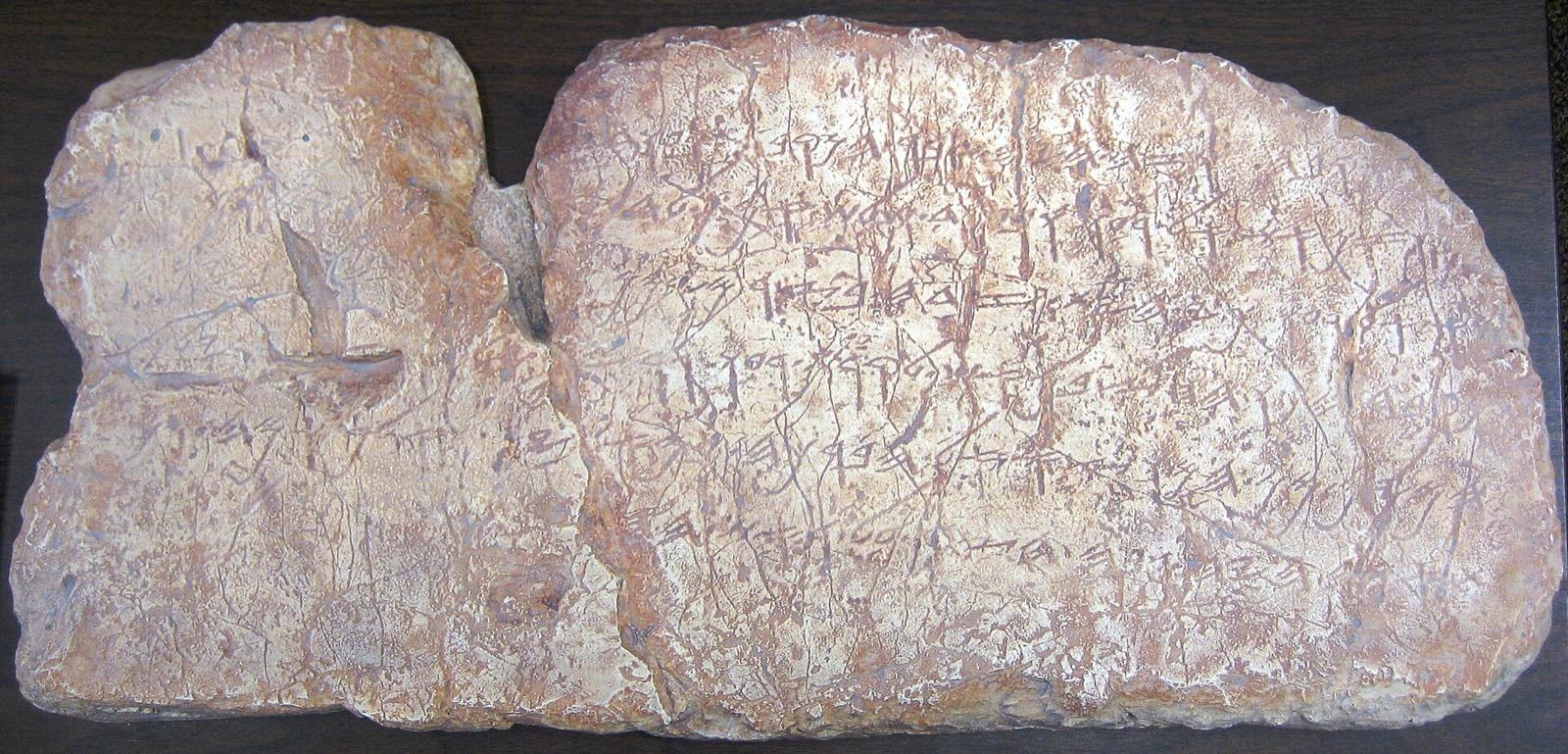
In 1880 a boy wading in the tunnel noticed an inscription near its southern end. Written in paleo-Hebrew script, it describes the last moments of the work. Two crews, digging toward each other with picks, heard each other’s voices through the rock and broke through “axe against axe,” and the water flowed 1,200 cubits to the pool. In 1890 the inscription was cut out of the wall, breaking into several pieces; Ottoman authorities recovered it and sent it to Istanbul, where it is in the Istanbul Archaeology Museums.
2 Kings 20:20 and 2 Chronicles 32:2–4, 30 say Hezekiah stopped the springs outside the city and brought the Gihon’s water down to the west side of the City of David, as Jerusalem prepared for the Assyrian invasion of 701 BC. A 2003 study in Nature radiocarbon-dated plant material in the tunnel’s original plaster to around 700 BC; uranium–thorium dates from stalactites that grew in the tunnel afterward gave a consistent minimum age.
Why it’s rated established
This rating covers the tunnel and its attribution to Hezekiah. The tunnel can be walked today and the inscription is in a museum; neither is in doubt. Radiocarbon dating of plant material in the tunnel’s plaster, published in 2003, points to about 700 BC, fitting Hezekiah’s reign, and most scholars accept the attribution. A minority have argued for an earlier or a later date, and the inscription itself names no king.
Established: Excavated, published and broadly accepted by scholars, with a direct link to the biblical text. About the ratings
In scripture
Timeline
- c. 705–701 BCHezekiah prepares Jerusalem’s defenses and water supply (2 Chronicles 32:2–5).
- 701 BCSennacherib invades Judah; Jerusalem is besieged but not taken (2 Kings 18–19).
- 1838Edward Robinson traces the tunnel’s full length.
- 1880The Siloam Inscription is discovered.
- 1890The inscription is cut from the wall; it is later taken to Istanbul.
- 2003Radiometric dating of the tunnel is published in Nature.
Sources
- Frumkin, Amos, Aryeh Shimron, and Jeff Rosenbaum. “Radiometric Dating of the Siloam Tunnel, Jerusalem.” Nature 425 (2003): 169–171. Link to this source
- Robinson, Edward. Biblical Researches in Palestine, Mount Sinai and Arabia Petraea. Vol. 1. Boston: Crocker & Brewster, 1841. Link to this source
- Rogerson, John, and Philip R. Davies. “Was the Siloam Tunnel Built by Hezekiah?” Biblical Archaeologist 59, no. 3 (1996): 138–149. Link to this source
- Hendel, Ronald S. “The Date of the Siloam Inscription: A Rejoinder to Rogerson and Davies.” Biblical Archaeologist 59, no. 4 (1996): 233–237. Link to this source
- Reich, Ronny, and Eli Shukron. “The Date of the Siloam Tunnel Reconsidered.” Tel Aviv 38, no. 2 (2011): 147–157. Link to this source
- Knauf, Ernst Axel. “Hezekiah or Manasseh? A Reconsideration of the Siloam Tunnel and Inscription.” Tel Aviv 28, no. 2 (2001): 281–287. Link to this source
Last reviewed October 14, 2026.