Tracing the Exodus Route
Scholars have proposed northern, central, southern and Arabian routes for Israel’s journey from Egypt to Sinai. Egyptian sites shed light on the setting, but archaeology has confirmed no route or campsite.

Exodus and Numbers give a detailed itinerary: from Rameses to Succoth, then Etham and Pi-hahiroth, across the sea, and on through the wilderness to Mount Sinai and Kadesh-barnea (Exodus 12:37; 13:20; 14:2; Numbers 33). Many of these places cannot be located with confidence today.
Some of the setting can be tested. Excavations at Qantir in the eastern Nile Delta have uncovered Pi-Ramesses, the capital Ramesses II built in the 13th century BC, which many identify with the store city Raamses of Exodus 1:11. James Hoffmeier of Trinity Evangelical Divinity School excavated forts at Tell el-Borg on the “Ways of Horus,” Egypt’s military road along the coast. That road matches “the way of the land of the Philistines,” which Exodus 13:17 says Israel avoided.
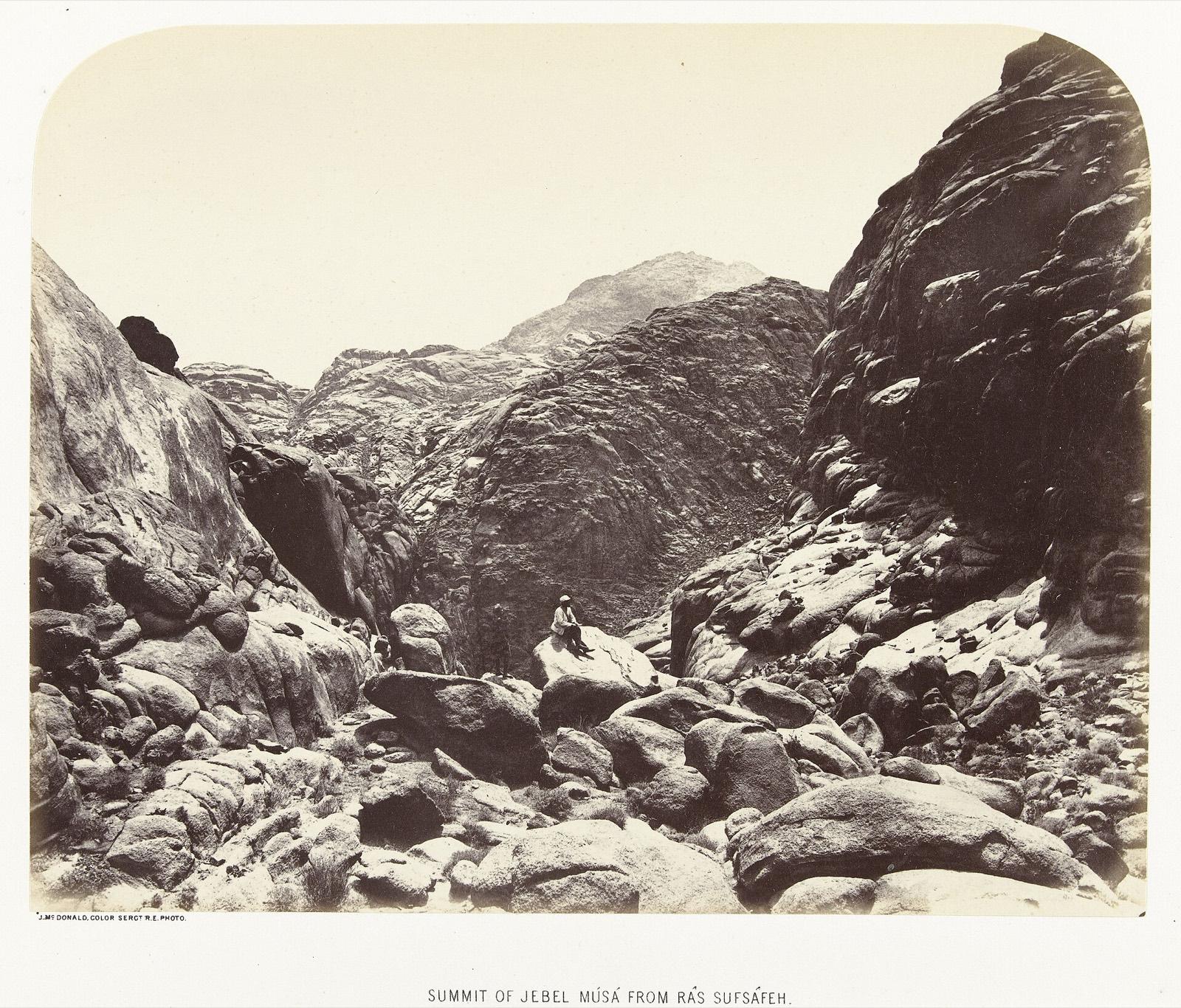
Mount Sinai has been placed at Jebel Musa in southern Sinai, venerated by Christians since at least the 4th century. St. Catherine’s Monastery at its foot is a Greek Orthodox monastery still in use today; rabbinic tradition did not fix the mountain’s location. Other proposals put Sinai in northern Sinai, in the Negev (Har Karkom), or in northwest Arabia, ancient Midian, which some critical scholars such as Frank Moore Cross have favored. One Arabian candidate, Jebel al-Lawz, was made popular by independent explorers such as Ron Wyatt and Bob Cornuke; most archaeologists, including evangelical ones, reject it. Excavations at Tell el-Qudeirat, the site most often identified as Kadesh-barnea, where Numbers says Israel spent much of the wilderness period, found Iron Age fortresses but nothing earlier.
Scholars disagree on what this absence means. Some argue that a large migration would leave traces, and that their absence counts against the story as history. Others note that nomadic camps rarely survive and that the Egyptian setting fits the story well. Many critical scholars think the story grew from the memory of a smaller group, and some doubt any exodus took place; others see the itinerary as reflecting the geography of a later period.
Why it’s rated unverified
This rating covers the proposed routes and the location of Mount Sinai. Egyptian archaeology sheds light on the story’s setting, such as the city of Pi-Ramesses and Egypt’s fortified road across northern Sinai. But no campsite or trail of a large group has been identified, and none of the proposed routes or locations for Mount Sinai is confirmed. Scholars disagree on whether a people living in tents would leave such traces.
Unverified: Claims without recovered, published or independently examined evidence. About the ratings
In scripture
Timeline
- c. 1446 BCA proposed early date for the Exodus, from 1 Kings 6:1.
- c. 1250 BCA proposed later date for the Exodus, in the reign of Ramesses II (Exodus 1:11).
- 4th century ADChristian monks venerate Jebel Musa as Mount Sinai.
- c. AD 565St. Catherine’s Monastery is completed under Emperor Justinian.
- 1976–1982Rudolph Cohen excavates Tell el-Qudeirat (Kadesh-barnea).
- 1999–2008James Hoffmeier excavates Tell el-Borg in northern Sinai.
Sources
- Hoffmeier, James K. Ancient Israel in Sinai: The Evidence for the Authenticity of the Wilderness Tradition. New York: Oxford University Press, 2005. Link to this source
- Hoffmeier, James K. Tell el-Borg I: Excavations in North Sinai. Winona Lake, IN: Eisenbrauns, 2014. Link to this source
- Bietak, Manfred. “Avaris and Piramesse: Archaeological Exploration in the Eastern Nile Delta.” Proceedings of the British Academy 65 (1979): 225–290.
- Cohen, Rudolph. “Did I Excavate Kadesh-Barnea?” Biblical Archaeology Review 7, no. 3 (1981). Link to this source
- Cohen, Rudolph, and Hannah Bernick-Greenberg. Excavations at Kadesh Barnea (Tell el-Qudeirat) 1976–1982. IAA Reports 34. Jerusalem: Israel Antiquities Authority, 2007. Link to this source
- Finkelstein, Israel, and Neil Asher Silberman. The Bible Unearthed: Archaeology’s New Vision of Ancient Israel and the Origin of Its Sacred Texts. New York: Free Press, 2001.
- Franz, Gordon. “Is Mount Sinai in Saudi Arabia?” Bible and Spade 13, no. 4 (2000): 101–113. Link to this source
Last reviewed October 14, 2026.