The Cyrus Cylinder
A clay cylinder in which Cyrus the Great of Persia describes conquering Babylon in 539 BC and returning displaced peoples and their gods to their homelands. Many historians see it as reflecting the kind of policy behind the decree in Ezra 1, though it does not mention the Jews.
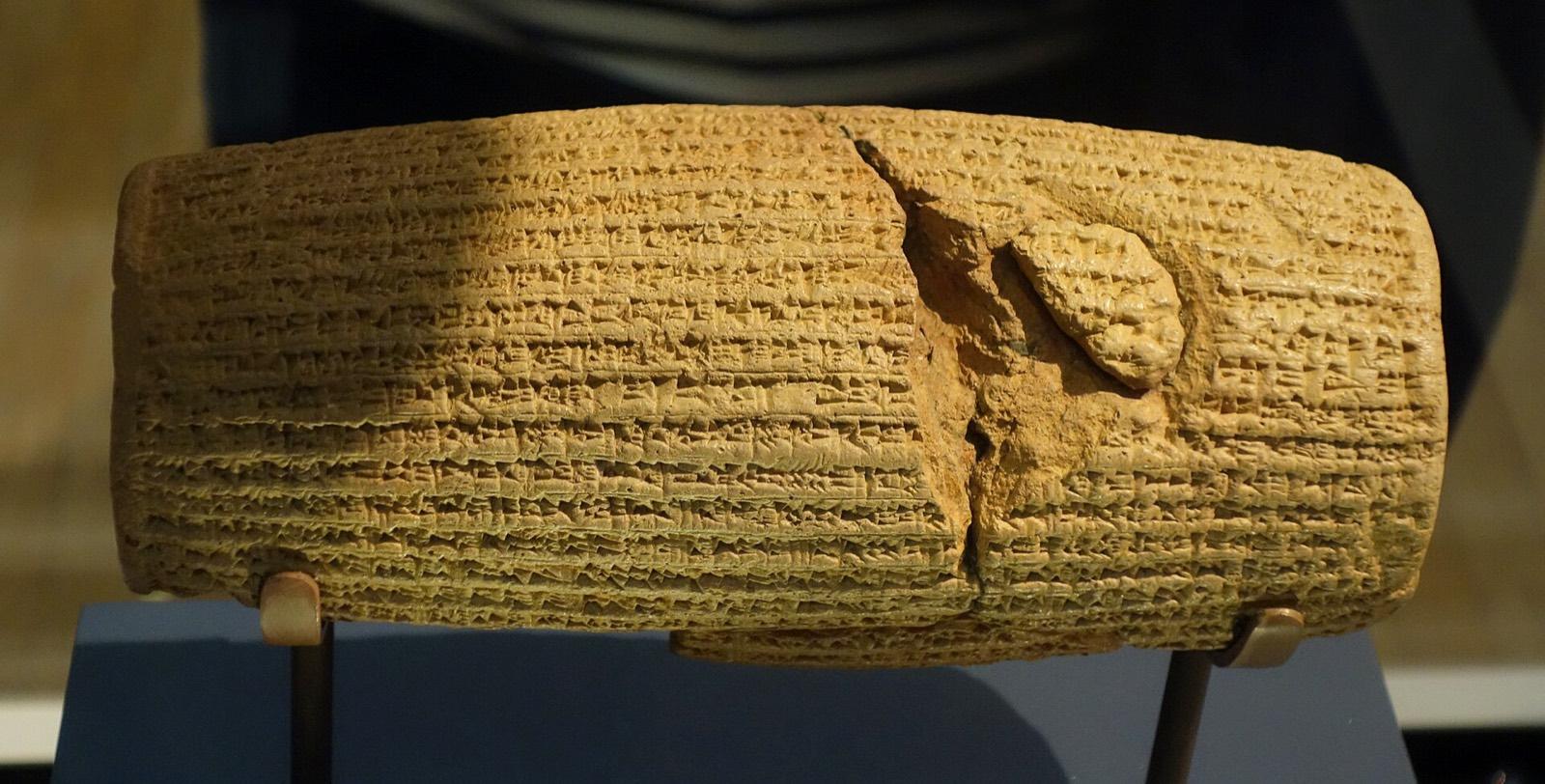

Hormuzd Rassam found the cylinder at Babylon in 1879, digging for the British Museum; his own accounts of the exact findspot differ. It was made as a foundation deposit, and its text describes Cyrus’s work on Babylon’s city wall. Written in Babylonian cuneiform, it presents Cyrus as chosen by Marduk to replace the impious Nabonidus, and as entering Babylon peacefully in 539 BC.
Cyrus says he returned the gods of several cities to their shrines and “gathered all their people and returned them to their settlements.” Ezra 1:1–4 and 2 Chronicles 36:22–23 report a proclamation in Cyrus’s first year allowing the Jews to return to Jerusalem and rebuild the house of the LORD. Ezra 6:2–5 says a record of the decree was later found at Ecbatana, and quotes it.
Isaiah 44:28 and 45:1 call Cyrus the LORD’s “shepherd” and “anointed.” Traditional Jewish and Christian readers take this as prophecy by the 8th-century Isaiah; most critical scholars date Isaiah 40–55 to the time of Cyrus. Many historians see the return of the exiles as fitting Cyrus’s practice of restoring local cults. Others, such as Amélie Kuhrt, caution that the cylinder is standard Babylonian royal propaganda and does not prove an empire-wide policy. The cylinder is in the British Museum.
Why it’s rated established
This rating covers the cylinder as Cyrus’s own account of taking Babylon and restoring sanctuaries. It is a genuine, well-understood royal text from British Museum excavations at Babylon, though its exact findspot was poorly recorded. Its connection to Ezra is indirect: it names only cities and gods in Mesopotamia and western Iran, not Judah or the Jews. Many historians see it as consistent with the tradition of a Cyrus edict in Ezra 1 and 6; others, such as Amélie Kuhrt, argue it reflects Babylonian royal convention rather than a general Persian policy. Scholars also debate how closely Ezra 1:2–4 preserves Cyrus’s words; the Aramaic record in Ezra 6:3–5 is more often accepted as authentic in substance.
Established: Excavated, published and broadly accepted by scholars, with a direct link to the biblical text. About the ratings
In scripture
Timeline
- 539 BCCyrus takes Babylon.
- c. 538 BCCyrus’s first year over Babylon; the decree of Ezra 1:1–4.
- 1879Hormuzd Rassam finds the cylinder at Babylon.
- 2010Two fragments of a clay tablet bearing the same text are identified in the British Museum.
Sources
- British Museum. “The Cyrus Cylinder” (1880,0617.1941). Link to this source
- Finkel, Irving, ed. The Cyrus Cylinder: The King of Persia’s Proclamation from Ancient Babylon. London: I.B. Tauris, 2013.
- Kuhrt, Amélie. “The Cyrus Cylinder and Achaemenid Imperial Policy.” Journal for the Study of the Old Testament 8, no. 25 (1983): 83–97. Link to this source
- Bickerman, Elias J. “The Edict of Cyrus in Ezra 1.” Journal of Biblical Literature 65, no. 3 (1946): 249–275. Link to this source
Last reviewed October 14, 2026.